Another solution, 82 bytes:
/// ( -> -0.5/// ) -> 0.5ClassMethod IsValid(sAs%String) As%Boolean
{
 s z=0,s=$zstrip(s,"*E",,"()") f  s c=$a(s,$i(i)) ret:c<0 'z ret:$i(z,c-40.5)>00
}- Log in to post comments
Another solution, 82 bytes:
/// ( -> -0.5/// ) -> 0.5ClassMethod IsValid(sAs%String) As%Boolean
{
s z=0,s=$zstrip(s,"*E",,"()") f s c=$a(s,$i(i)) ret:c<0 'z ret:$i(z,c-40.5)>00
}Variant 69 bytes:
ClassMethod IsValid(sAs%String) As%Boolean
{
1s c=$a(s,$i(i)) q:c<0 '$g(z) g:"()"'[$c(c) 1q:$i(z,c-40.5)>00 g 1
}Well done! Don't worry about your brain 😉
; 67 bytes improvement by Julius Kavay1s c=$a(s,$i(i)) q:c<0 '$g(z) g:c=41-c+401q:$i(z,c-40.5)>00 g 1Wonderful!
Hello @Michael Davidovich ,
Did you try to override OnPreDispatch ?
Also you can configure your web application to use a subclass of %CSP.SessionEvents and override OnStartRequest, OnEndRequest .
Set Application = "/csp/YourWebApp"Do##class(Security.Applications).Get(Application, .p)
Set p("EventClass") = "YourCSPEventsClassName"Set sc = ##class(Security.Applications).Modify(Application, .p)Hi @Guillaume Rongier !
Thank you!
Yes, I continue working on this project after writing this article.
I have to write a sequel.
You can see a summary of the activity on this dashboard : 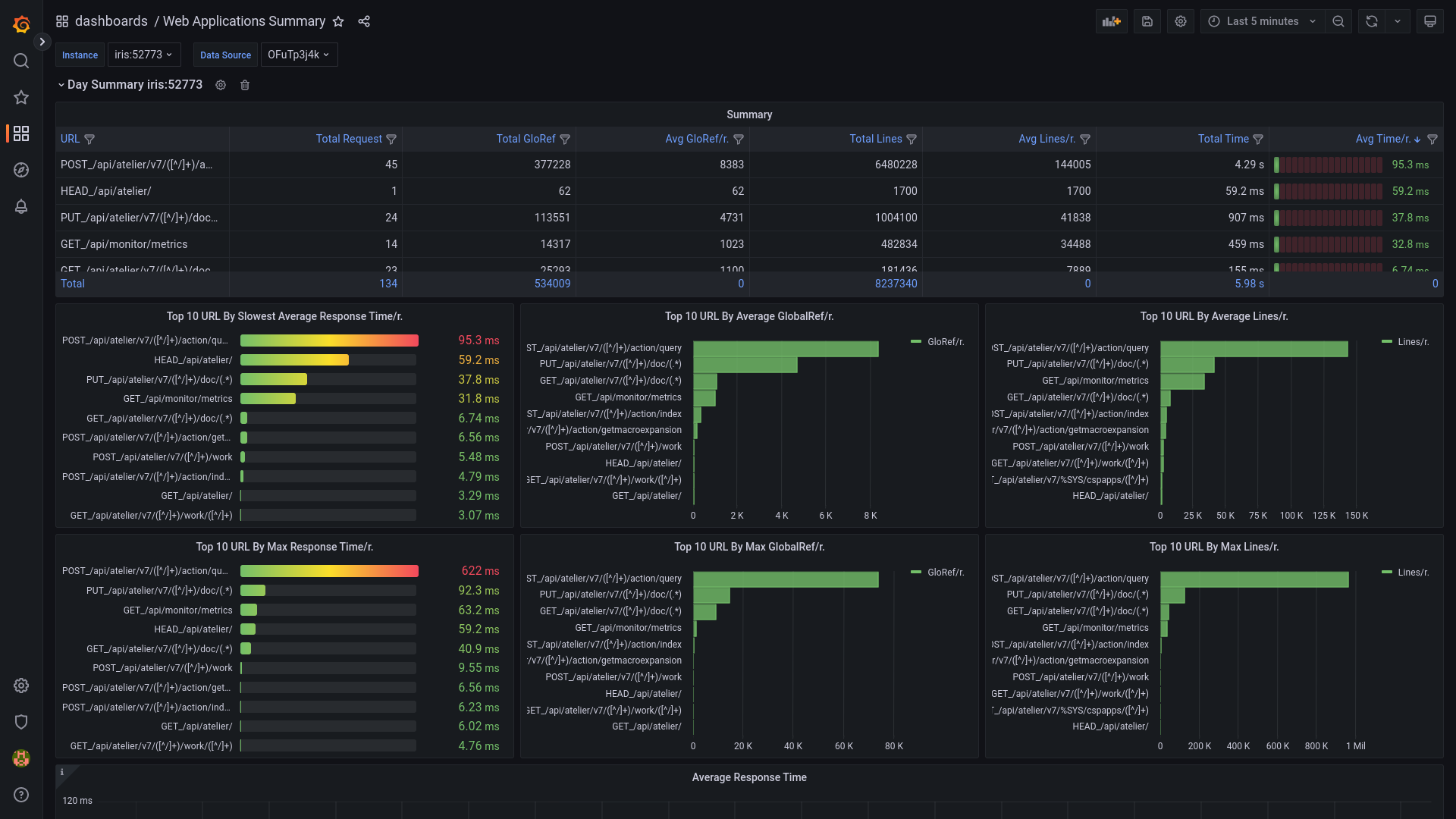
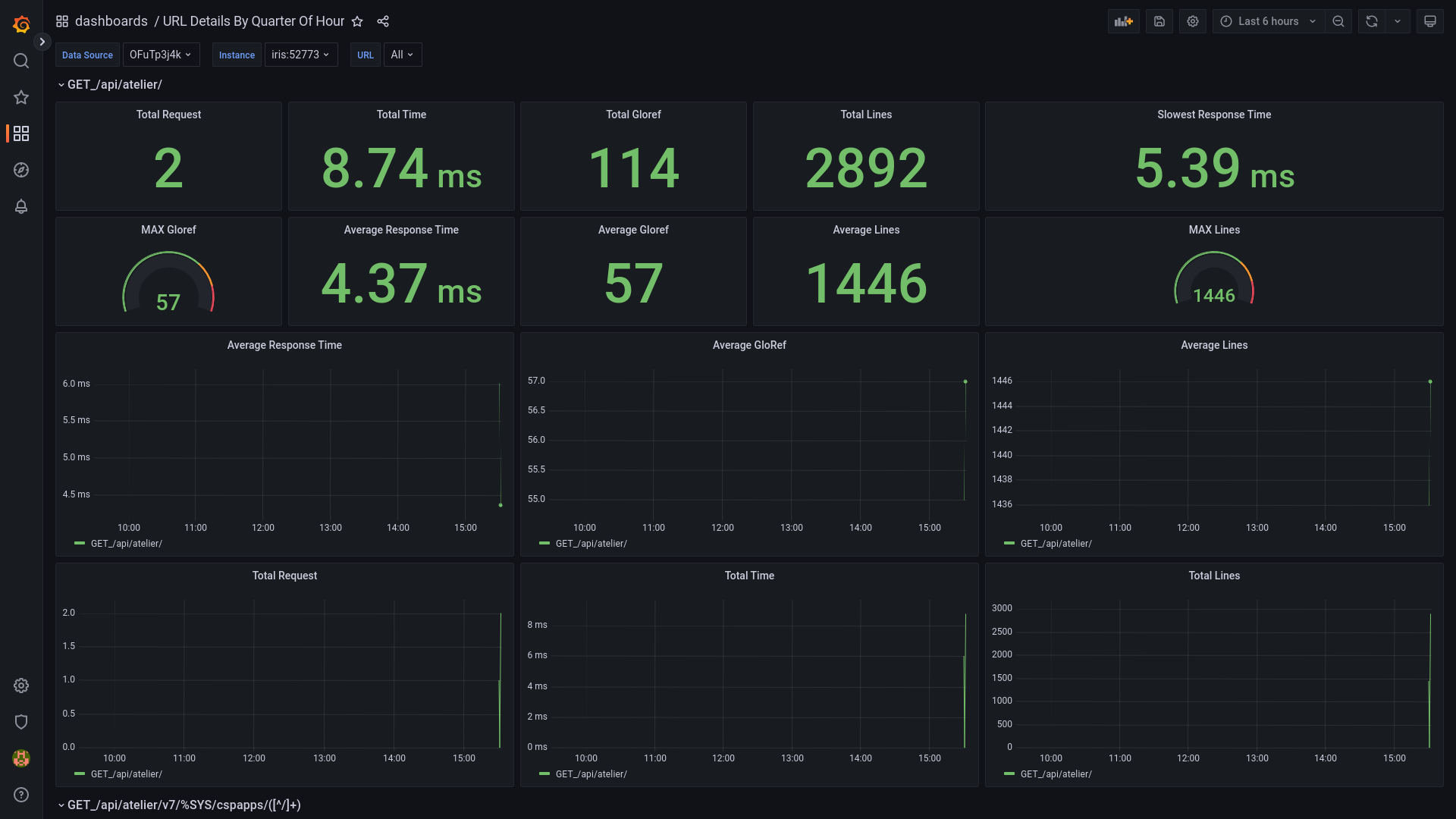
And the detail for a CSP\REST here:
Thank you for this report @Guillaume Rongier
I checked my deployment scripts, fortunately, they are already using HS.Util.Installer.Foundation.
Ho interesting! I never noticed the flag argument of the function $ListToString.
Congratulations!
Thank you for your report! I'll try these specifications.
Yes, we can discuss on Discord or using 'issue' on the GitHub page.
What operation did you do? (generate simple HTTP client or client production?)
Hi @Theo Stolker ,
I just tested the "DID Manager" specification.
With the simple http client, I noticed a code generation issue with double-quoted HTTP status code. It's fixed.
I see a generated model like model.CompoundServicePropertiesserviceEndpoint empty.
So, If we check the specification and we can see:
        serviceEndpoint:
          description: A map containing service references and/or endpoints.
          example: { 'auth': 'did:nuts:EwVMYK2ugaMvRHUbGFBhuyF423JuNQbtpes35eHhkQic/serviceEndpoint?type=auth' }
          type: object
It's a type object, but there is no schema defined, so we can't generate any properties in this case.
This is the same problem with the model model.OrganizationSearchResultorganization.
I also noticed external references in the specification file like :
        didDocument:
          $ref: '../common/ssi_types.yaml#/components/schemas/DIDDocument'
Indeed, this case is not supported. I haven't checked for all the specs, but I think the 2 cases noted are the cause for the empty models.
If we specify a URL, maybe it would be possible to download the external ref and load the definition (to analyze...).
Thank you very much for your contribution @Theo Stolker .
Your pull request is merged and a new release on OEX has been published.
I'm still wondering if there is a simple way to resolve external references, I'll check if something help with validator.swagger.io (this tools is already used by OpenAPI suite). There is an option for external ref but I don't know yet what that implies, I have to test that.
Finally, there is a solution @Theo Stolker .
If I parse by URL and send parameters "resolveFully=true" and "validateExternalRefs=true", the specification is fully resolved including external references. I can't commit\push this update directly, because if a user puts a URL only accessible from inside his organization, It does not work. It's not really a problem because the validator tools can be run locally in a container, but I have to update the documentation too.
I created the related issue 9 to follow the progression. I can't continue anymore this morning. I'll continue this evening.
Hi @Robert Cemper ,
Stats very interesting to know.
I'm glad to read the French Community is reactive 😄.
This weekend I've been working on integrating code from @Theo Stolker and bug fixes about openapi-suite. I was very happy to have a contribution.
I noticed all issues (tasks for improvement in fact) of a project currently in active development were opened, but already done. With Kanban it's not enough to move an issue to "done status", we have to close explicitly. I probably raised your stats with this repository journal-indexer.
Hi @Raj Singh
Just a suggestion:
Maybe identify "dark corner" candidates by checking if:
Send a notification to the owner and if there is no fix after a period (x months, to be determined) move the package to the "dark corner".
Thank you very much for describing how to use JWT auth with IRIS web app.
How do you solve the problem with cross-origin for development? (Basically we use the port 4200 in development mode)
I tested with the Parameter HandleCorsRequest = 1; in the dispatch class, also setup an Event class (%CSP.SessionEvents) to force the response header Access-Control-Allow-Origin to "*" but something was wrong.
The problem occurs the /login usage, not with others services in my route map
If you experienced the same problem, I'm interested in your solution :)
Thank you.
Thank you for the tips @Luis Angel Pérez Ramos !
I'll test it this evening.
Hi @Dmitry Maslennikov ,
Yesterday I experienced this kind of problem with web socket.
To limit the license usage, I did this :
Class dc.journalindexer.WebSocket Extends%CSP.WebSocket
{

Method OnPreServer() As%Status
{
    Do%session.Login("wsuser",,1)
    Set..SharedConnection = 1; ... some lines of codeQuit sc
}

Method OnClientMessage(
	data As%String = "",
	closeAs%Integer) As%Status
{
    ; force logout and EndSession on disconnect from clientIf$Get(close) = 1 {
        Do%session.Logout()
        Set%session.EndSession = 1Do..EndServer()
    }

	Quit0
}
}It works!
Thank you @Luis Angel Pérez Ramos
Thank you @Vadim Aniskin !
Congrats !!
Congratulations!
Hi @Davi Massaru Teixeira Muta ,
As far as i know, there is no lock log history.
This is understandable, as there would be a lot of them on heavily used systems.
If you can modify the application code, may be you can add log trace when this error happens.
With ^$LOCK you can retrieve the owner of a lock.
Example:
Lock +^my.global(1)
Write"Owner is : ", ^$LOCK($Name(^my.global(1)),"OWNER")
;Owner is : 5216
Even if you recover the PID, analysis can be difficult if the process no longer exists at the time you perform the analysis. Maybe add something like this for logging (executed with a job):
/// Start this method in job ex:/// Job ##class(pkg.ClassName).TraceLock($Name(^my.global))ClassMethod TraceLock(lockname As%String) As%Status
{
    Set sc = $$$OKSet pid = ^$LOCK(lockname, "OWNER")
    If pid = "", $QLength(lockname)>0 {
        ; check if the node is fully lockedSet pid = ^$LOCK($QSubscript(lockname,0), "OWNER")
    }

    If pid = "" {
        ; no data ...Return sc
    }

    Set key = $Increment(^debug.locktrace)

    Set^debug.locktrace(key, "from pid") = $ZParent; Just to keep a trace of the pid started this jobSet^debug.locktrace(key, "info") = $ZDateTime($Horolog, 3, 1) _ " The lock " _ lockname _ " owner is "_pid

    Set process = ##CLASS(%SYS.ProcessQuery).Open(pid)
    If$IsObject(process) {
        Set^debug.locktrace(key, "owner-UserName") = process.UserName
        Set^debug.locktrace(key, "owner-StartupClientIPAddress") = process.StartupClientIPAddress
        Set^debug.locktrace(key, "owner-StartupClientNodeName") = process.StartupClientNodeName
        Set^debug.locktrace(key, "owner-CurrentLineAndRoutine") = process.CurrentLineAndRoutine
        Set^debug.locktrace(key, "owner-Routine") = process.Routine
    }

    Return$$$OK; Exemple of result:;^debug.locktrace=1;^debug.locktrace(1,"from pid")=12964;^debug.locktrace(1,"info")="2024-11-22 12:25:25 The lock ^my.global owner is 5216";^debug.locktrace(1,"owner-CurrentLineAndRoutine")="";^debug.locktrace(1,"owner-Routine")="shell";^debug.locktrace(1,"owner-StartupClientIPAddress")="127.0.0.1";^debug.locktrace(1,"owner-StartupClientNodeName")="TRM:";^debug.locktrace(1,"owner-UserName")="_SYSTEM"
}
Hope this help.
Lorenzo.
Hi @Evgeny Shvarov !
I've just seen your message, I'll try to rebuild this project tomorrow, as I haven't had the opportunity to use it for a while. I'm sure I've got a simple specification to test somewhere.
If you want, you can send me your specification by private message (discord) and I'll test it :)
Great!
Probably an oversight in the return type when generating the code.
I'll take a look.
Yes, that's it!
The methods generated in the “impl” class must return a %DynamicObject. I think %WriteResponse accepts string, stream or %DynamicObject as parameters, but the most common usage is still %DynamicObject (The developer will always be free to modify according to his implementation) . I'll put an issue on github for follow-up and fix it.
edit: done in version 1.1.1