1. Integrated ML Demonstration
This repository is a demonstration of IntegratedML and Embedded Python.

Embedded Python refers to the integration of the Python programming language into the InterSystems IRIS kernel, allowing developers to operate with data and develop business logic for server-side applications using Python.
This repository is a demonstration of IntegratedML and Embedded Python.
In the previous articles, we learned the basics of using IMAP protocol to handle messages from mailboxes in an e-mail server. That was cool and interesting, but you could take advantage of implementations created by other ones, available in libraries ready to use.
One of the improvements to the IRIS data platform is the ability to write Python code alongside ObjectScript in the same IRIS process. This new feature is called Embedded Python. Embedded Python lets us bring to our ObjectScript code the power of the huge Python ecosystem’s libraries.
Hi Developers!
Here're the technology bonuses for the InterSystems "Sustainability" Interoperability Contest 2022 that will give you extra points in the voting:
See the details below.

In the August Learning Services newsletter, see how you can get hands-on with healthcare analytics tools, Embedded Python, and InterSystems Package Manager. If you're new to InterSystems ObjectScript, try out a learning path to get started!
In this article you will have access to the curated base of articles from the InterSystems Developer Community of the most relevant topics to learning InterSystems IRIS. Find top published articles ranked by Machine Learning, Embedded Python, JSON, API and REST Applications, Manage and Configure InterSystems Environments, Docker and Cloud, VSCode, SQL, Analytics/BI, Globals, Security, DevOps, Interoperability, Native API. Learn and Enjoy!
Hey Developers,
Enjoy watching the new video on InterSystems Developers YouTube channel:
I am aware that we have 5 License Units on Community Edition. But I have issues figuring out how it's working.
I have Community Edition
USER>write $system.License.KeyCustomerName()
InterSystems IRIS Community
Freshly started system, only terminal session open, so, only one license units used, and 4 left. As expected
USER>write $system.License.LUConsumed()
1
USER>write $system.License.LUAvailable()
4
Quote from documentation - $SYSTEM.License.MaxConnections() returns the maximum number of connections a user can make while consuming one license unit.
Hi Developers!
We have great new articles for your to read and enjoy, thanks to our wonderful participants of the 3rd InterSystems Tech Article Contest: Python Edition!
And now it's time to announce the winners!
Let's meet the winners and their articles:
Continuing to observe the possibilities of Django, and usage with IRIS. The first we have looked how to define models and connect to tables already existing in IRIS, than we extended embedded Django Administration portal, with an ability to see what data we have in that models, with filters, editing and even pagination.
Time to go to real action, now we a going to create some REST API, on Django, based on the same data, we used before from the package posts-and-tags.
To do so, we will use Django REST Framework
Django REST framework is a powerful and flexible toolkit for building Web APIs.

Hey Community!
Here are the bonuses for participants' articles that take part in InterSystems Tech Article Contest: Python Edition:
Following this GitHub we will see how the FIX protocol can be implemented easily using IRIS and Python.
If you don't have much time focus on the Send a Quote before the Order part near the end, as it will, in a matter of minute, tell you how to send a Quote Request followed by an Order Request and show you the result from the server, and that in no more than five clicks.
Implementation of the fix protocol using an IRIS python container for the initiator and a regular python container for the acceptor.
Hello,
I became aware of Python in the early 2000s when I started automating tasks. Some of our processes utilized python scripts. I never figured it out very well, and we decided to do away with Python because nobody on our team was familiar with it.
Along the way, I heard a lot about Python. My interest was renewed when InterSystems offered bonus points for using Python in contests.
The things I like the most about Python so far is how easy it is to find the mean of the ages of all Titanic passengers. For my test-data app I wanted to find the largest value in the ‘Qty’ column in a CSV file.
Hi Community,
We are excited to announce that InterSystems Developers Meetups are finally back in person!
The first Python-related meetup will take place on July 21 at 6:00 at Democracy Brewing, Boston, MA. There will be 2-3 short presentations related to Python, Q&A, networking sessions as well as free beer with snacks and brewery tours.
AGENDA:
Hi Community,
This post is a introduction of my open exchange iris-climate-change application.
iris-climate-change web application Imports The Food and Agriculture Organization (FAO) Climate Change dataset by using LOAD DATA (SQL) functionality and analyze and visualize data with the help of Python Flask Web Framework, Pandas Python data analysis Library, Plotly Open Source Graphing Library for Python and Plotly JavaScript Open Source Graphing Library.
I think it's a known fact that Populate Utility has very limited functionality. It supports only one language and one country. The list of possible values does not have so many options.
There is a kind of tool that now can help with it, named Faker. It has implementations in different languages, including Python. Since IRIS has now had the Embedded Python feature, Python faker can be implemented in IRIS.
This formation, accessible on my GitHub, will cover, in half a hour, how to read and write in csv and txt files, insert and get inside the IRIS database and a distant database using Postgres or how to use a FLASK API, all of that using the Interoperability framework using ONLY Python following the PEP8 convention.
This formation can mostly be done using copy paste and will guide you through everystep before challenging you with a global exercise.
We are available to answer any question or doubt in the comment of that post, on teams or even by mail at lucas.enard@intersystems.com .
This project was thought of when I was thinking of how to let Python code deal naturally with the scalable storage and efficient retrieving mechanism given by IRIS globals, through Embedded Python.
My initial idea was to create a kind of Python dictionary implementation using globals, but soon I realized that I should deal with object abstraction first.
So, I started creating some Python classes that could wrap Python objects, storing and retrieving their data in globals, i.e., serializing and deserializing Python objects in IRIS globals.
You may have seen my series of articles on GlobalToJSON closing with Embedded Python.
And to me, Embedded means inside a Class and not PEX or other external variants.
The first variants showed that ePy is not an ultimate requirement. ISOS/COS may do it as well.
Here I try to position ePy inside IRIS.
Hi Community,
This article will demonstrate how to create Patient and Patient Observation Resources by using iris-fhir-client application.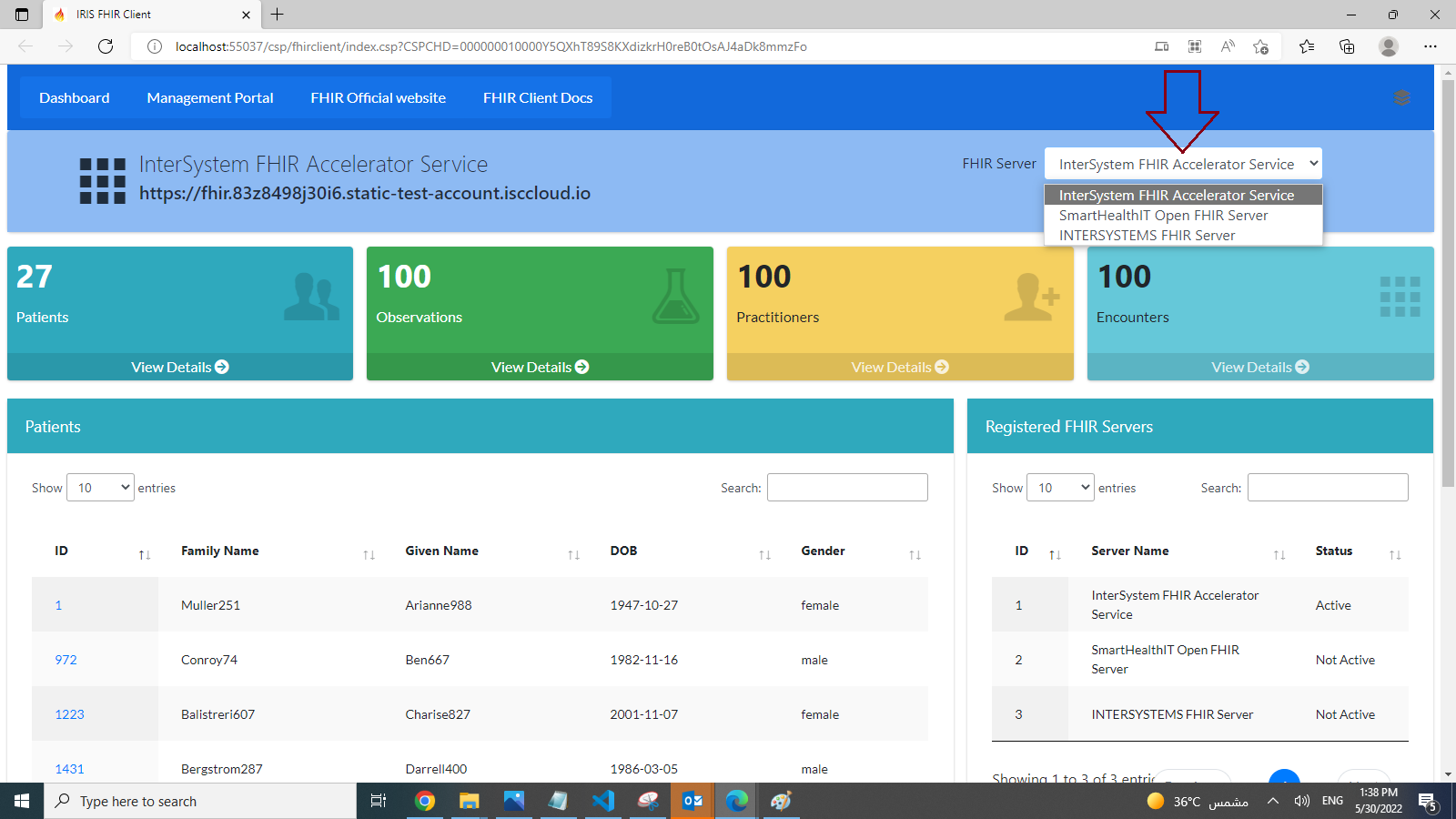
I recommend to read my first article about this app and watch Youtube Video before continue
so let's start
It is very interesting to compare different BI technologies. It is curious to me what the differences are in functionality, development tools, speed and usability.
For this application, I chose a dataset with water conditions in various European countries. This is an open source dataset containing observational data from 1991 to 2017.
The team and I decided to make a model based on this BI dataset using IRIS BI, Tableau, PowerBI and InterSystems Reports (powered by Logi Reports).
For the frontend, we made a web interface in PythonFlask via Embedded Python.
Hi Community,
This post is a introduction of my open exchange iris-fhir-client application.
iris-fhir-client can connect to any open FHIR Server by using embedded python with the help of fhirpy Library.
Get Resource information by terminal and by using CSP web application.
One of the crucial business dimensions is the dimension “Where”. It is necessary to know where a customer was born or where he lives. Where will the order be delivered? Where have there been more sales, and where can we sell more? Where are our stores located? From Where is the customer accessing our e-commerce? These and other principal questions use the “Where” dimension. Today the best service to provide geographic accuracy and quality for these data is Google Maps. Taking advantage of the Python support of the new IRIS (2021.2+), we can use the Geocoder library
Hi Community,
Imagine enabling your application to read text to your customer? This is now possible with the new IRIS feature, Embedded Python. With this new functionality IRIS can natively run any open source or commercial Python libraries natively. gTTS (https://pypi.org/project/gTTS/) is a free library that transforms text into audio using the Google Translate service.
Just pass the text by parameter and gTTS returns an mp3 file with the text transformed into audio. That is, your application can play the audio of any text! See how to do it:
To Programmatically Edit Productions (interfaces) you can use a combination of the interoperability apis and SQL queries.
At a high level, it is important to know the namespace and production you are working in at the moment.
// Object script
// The active namespace is stored in this variable
$$$NAMESPACE
// Print namespace
Write $$$NAMESPACE
# Python
import iris
# The active namespace is returned from this method
iris.utils._OriginalNamespace()
# Print namespace
print(iris.utils._OriginalNamespace())
>>> DEMONSTRATION
How can I get the Python error object(exception return value) from the embedded python method?
I have an embedded Python method like as below;
ClassMethod test2() As XXX [ Language = python ]
{
   try:
    a=1/0

   except Exception as ex:
    print("Exception: %s" % str(ex))
    return ex
}
I'm not sure what kind of return type to set for this classmethod. "As XXX" <--
I tried to set "ClassMethod test2() As %Exception.PythonException [ Language = python ]"
However, I got the following return value when I run the method in the IRIS terminal.
All of us know that money is important. We constantly need to monitor all expenses to avoid looking back to the bank statement and thinking: “So, where’s my money?”
To evade financial stress, we must keep an eye on the inflow and outflow of money into our accounts.It is also important to tack when and how we spend and earn. Manually recording all transactions in order to understand where our money goes requires an effort. It demands consistency, and it is boring. Today there is a bunch of mobile or SaaS options that help you manage your finances.

See what's new in InterSystems Learning Services! In the March 2022 newsletter, you will:
This example demonstrates the difference you may experience when you write to
Gllobals directly from Embedded Python compared to native ObjectScript.
To make this demo useful I start 2 background jobs that simply write sequentially
to a dedicated global. A common control method signals for a synchronous start.
Similar a common stop & view interrupts data feeding.
That's the principle process:

Hi Community,
We're pleased to invite you to the upcoming webinar in Spanish called "Exploring the new Embedded Python feature of InterSystems IRIS"
Date & Time: March 30, 4:00 PM CEST
Speaker: @Eduardo Anglada, Sales Engineer, InterSystems Iberia
It sounds strange though it's embarrassing.
I have a class with ClassMethods written in ISOS and Embedded Python.
The ClassMethods written in ISOS start in the Background as usual. No problems
But my
ClassMethod setPy() [ Language = python ]
{
import iris, datetime, time
- - -
Just fails the JOB command with (even 15 sec) timeout and $ZC=0
This is not funny
My actual workaround:
I created a ClassMethod in ISOS, that does an elegant JobStart
and this ClassMethod only runs the Embedded Python ClassMethod.
I'm not amused and hope there is just an undocumented/unknown param missing